21 November 2026
|4:21 pm
|Aanetic Advisory Editorial
Explore the Best PCI DSS Audit Services in India for payment security assessments, compliance gap analysis, remediation support and audit readiness.
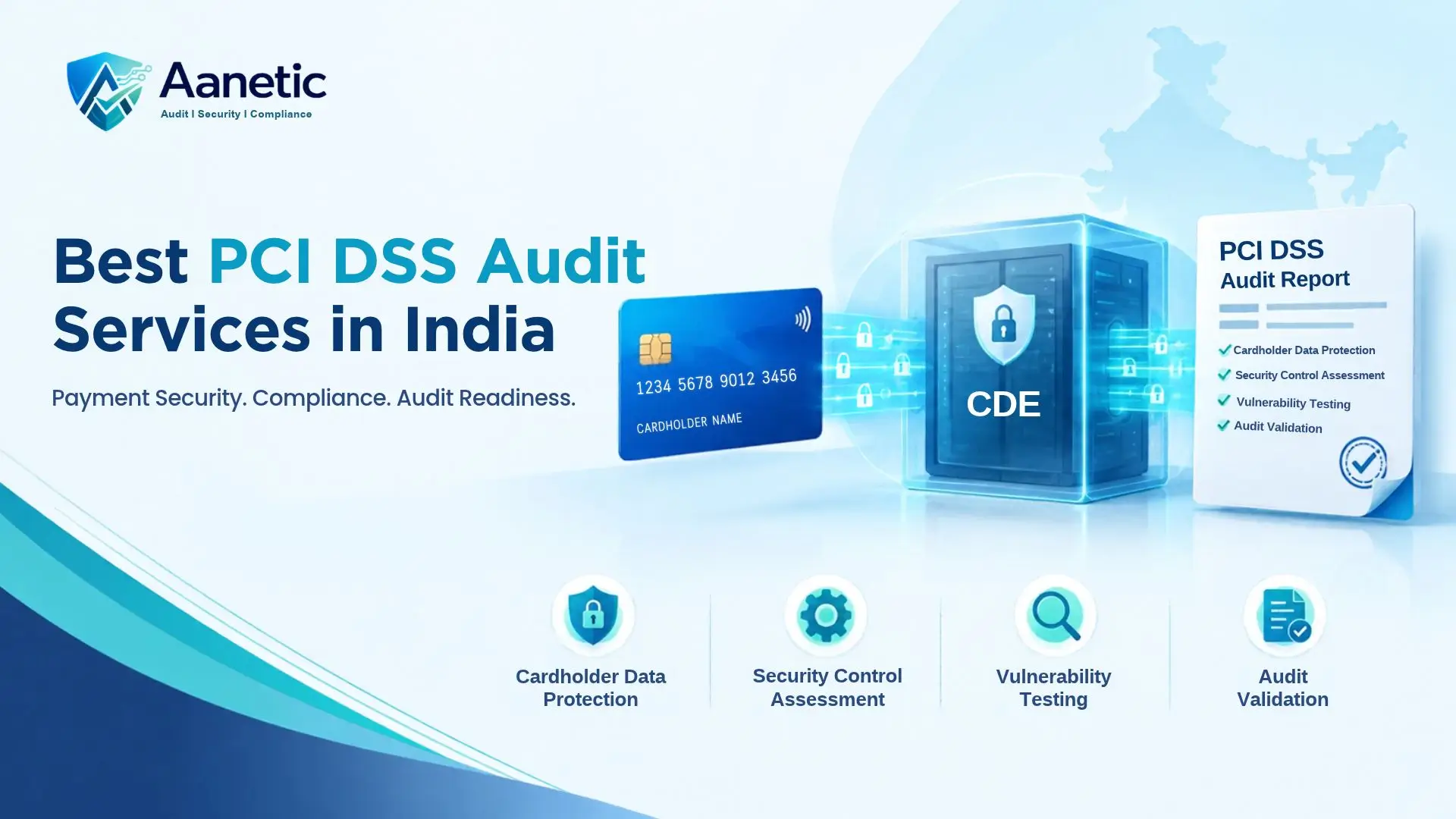
The Best PCI DSS Audit Services in India help businesses evaluate payment security controls, identify compliance gaps and prepare for the applicable PCI DSS validation process. For organizations that handle payment card information, protecting customer data is not simply an IT responsibility. It involves secure payment systems, controlled access, effective monitoring, vulnerability management and documented security practices.
As digital payments expand across fintech, e-commerce, banking and merchant environments, businesses need a clear understanding of how payment data moves through their systems. A structured PCI DSS assessment can help identify weaknesses before they affect customers or business relationships. This guide explains the standard, the role of audit and readiness services, the assessment journey and the factors to consider when selecting a provider.
The Payment Card Industry Data Security Standard (PCI DSS) is a global security standard developed by the PCI Security Standards Council (PCI SSC). It establishes technical and operational requirements to protect payment account data wherever it is stored, processed, or transmitted. PCI SSC is the organization responsible for developing and maintaining the standard with participation from the payment card industry.
PCI DSS applies to merchants and service providers that store, process or transmit cardholder data or sensitive authentication data. It can also apply to organizations that may affect the security of the cardholder data environment, even when they do not directly handle payment card data. The actual scope depends on the services, systems, connections and responsibilities involved. PCI SSC guidance.
As of November 2026, PCI DSS v4.0.1 is the active version. It became the only active version after PCI DSS v4.0 was retired on 31 December 2024. The future-dated requirements also became effective on 31 March 2025, so organizations should assess applicable controls against the current requirements in full.
For an Indian payment gateway, this may involve reviewing transaction infrastructure, access permissions and third-party connections. For an online retailer, it may mean checking how payment pages, integrations and service providers affect payment security. PCI DSS compliance supports stronger protection and helps businesses meet relevant payment partner expectations, but it does not guarantee that security incidents will never occur.
PCI DSS audit services help organizations assess whether their payment environment meets applicable security requirements and identify what needs attention before formal validation. The work generally begins with scope identification, including the Cardholder Data Environment (CDE), connected systems, people, processes and third-party services.
A gap assessment compares existing practices with applicable PCI DSS requirements. It may review network security, system configurations, access control, authentication, encryption, vulnerability management, logging, monitoring and security policies. The review also considers whether evidence is available to demonstrate that controls are operating as expected.
Readiness support can include documentation review, evidence preparation, remediation planning, vulnerability assessment coordination and validation of corrective actions. However, readiness consulting is not the same as an independent PCI DSS assessment. Where a formal assessment by a Qualified Security Assessor (QSA) is required, the assessment must be performed by an appropriately qualified QSA. An Approved Scanning Vendor (ASV) performs external vulnerability scans where the PCI DSS program requires them. A readiness consultant cannot replace either role.
Payment environments often involve multiple applications, cloud platforms, payment processors and external service providers. A weakness in one connected system can create risk for the wider payment environment. For example, an e-commerce business may use an external payment gateway but still need to understand whether its website, scripts, hosting arrangements or administrative access affect the security of payment transactions.
The Best PCI DSS Audit Services in India should help organizations identify these dependencies rather than treat compliance as a document-only exercise. A practical review can reveal excessive user permissions, outdated software, weak network segmentation, incomplete security logs, or missing evidence of vulnerability remediation.
For fintech companies and payment aggregators, structured reviews can also clarify responsibility between the organization and its technology partners. This is particularly important when a third-party service provider performs activities that support PCI DSS requirements. Businesses should understand which controls are managed by the provider and which remain their own responsibility.
Choosing a PCI DSS provider requires more than comparing service descriptions or prices. Look for practical knowledge of PCI DSS v4.0.1, experience with merchant and service-provider environments, and a clearly explained assessment methodology. The provider should be able to discuss scoping, evidence expectations, remediation priorities and the validation route relevant to your organisation.
Before appointing a provider, clarify who will perform the formal assessment and whether a QSA is required for your validation. Verify any claimed QSA or ASV status through the official PCI SSC listings. Ask how the engagement will address the Report on Compliance (ROC), Self-Assessment Questionnaire (SAQ) and Attestation of Compliance (AOC), where applicable. Also review the proposed deliverables, timelines, responsibilities and communication process.
The Best PCI DSS Audit Services in India should provide clear guidance without promising guaranteed compliance. A credible provider will explain limitations, identify dependencies and distinguish between recommendations, remediation work and formal assessment activities.
PCI DSS organizes its security expectations into 12 principal requirement areas. In simple terms, these cover:
Network security controls: Establish and maintain controls that protect networks and system connections.
Secure configurations: Remove default weaknesses and configure systems securely.
Stored account data: Protect stored payment account data and limit retention.
Data in transit: Use strong cryptography to protect cardholder data across open, public networks.
Malware protection: Defend systems against malicious software.
Secure systems and software: Develop, maintain and update systems securely.
Access restrictions: Give users access only to the data and systems required for their roles.
User identification: Assign unique identities and apply appropriate authentication.
Physical security: Prevent unauthorized physical access to systems and cardholder data.
Logging and monitoring: Record and monitor access to systems and payment data.
Security testing: Test systems and networks regularly to identify weaknesses.
Information security program: Maintain policies, responsibilities and processes that support security.
These areas provide a useful overview, not a substitute for the standard. The exact requirements and testing procedures depend on the organization's role, environment and assessment scope.
A well-managed engagement follows a sequence that connects technical review with the organization's validation obligations.
Initial consultation: Understand the business model, payment channels, services and requirements communicated by the acquiring bank or payment brand.
Scope identification: Map the CDE, connected systems, network paths, locations and third-party responsibilities.
Gap assessment: Compare existing controls with the PCI DSS requirements that apply to the environment.
Control and evidence review: Examine configurations, policies, access records, scan results, monitoring evidence and other relevant documentation.
Remediation: Prioritize gaps, assign owners and implement corrective measures.
Readiness validation: Review whether remediation is complete and supporting evidence is available.
Formal assessment: Engage the appropriate assessor when a QSA assessment is required.
Compliance documentation: Complete the applicable validation documents and submit them through the required compliance channel.
Three terms are important. A Report on Compliance (ROC) records the detailed results of a formal assessment. A Self-Assessment Questionnaire (SAQ) is used by eligible entities to document their self-assessment. An Attestation of Compliance (AOC) is the formal attestation document associated with an assessment or self-assessment. The required route is not identical for every business; confirm it with the acquiring bank, payment brand, or other compliance-accepting entity.
PCI DSS may be relevant to banks, financial institutions, payment gateways, payment processors, fintech companies, payment aggregators, e-commerce platforms, retailers and other merchants that handle payment card data. SaaS, hosting and infrastructure providers may also fall within scope when their services store, process or transmit account data or can affect the security of the payment environment.
The Best PCI DSS Audit Services in India should account for these different operating models. A merchant using a hosted payment page may have a different scope from a payment processor operating its own transaction platform. Neither business should assume that outsourcing payment processing automatically removes all PCI DSS responsibilities. Scope and validation eligibility must be confirmed for the actual environment.
Aanetic provides PCI DSS audit and compliance-related services for organizations working towards payment security readiness. Its published service information describes support around CDE scoping, requirement reviews, gap identification, evidence and documentation, remediation priorities and preparation for applicable validation routes. Businesses can explore the PCI DSS Audit and Compliance Assessment service to understand the areas covered
Aanetic also lists a PCI DSS compliance tool that supports activities such as requirement mapping, evidence management and readiness tracking. Technology can make compliance activities easier to organize, but it does not independently establish compliance or replace the judgment and testing of a qualified assessor.
When evaluating the Best PCI DSS Audit Services in India, organizations should clarify the exact scope of Aanetic's engagement, the individuals or organizations responsible for the formal assessment, and whether a QSA or ASV must be engaged separately. This helps ensure that readiness work and formal validation are clearly distinguished from the beginning.
Start by documenting every payment channel and identifying the systems that store, process or transmit cardholder data. Map connections to business applications, cloud infrastructure, networks and third-party providers. Review access permissions and authentication practices, and remove accounts or privileges that are no longer needed.
Next, check network configurations, encryption practices, vulnerability management records and security monitoring. Make sure policies and incident response procedures reflect how the business actually operates. Keep evidence organized, assign owners to outstanding issues and track remediation until each item has been reviewed. Early preparation gives teams time to address weaknesses before a formal assessment begins.
The Best PCI DSS Audit Services in India should help turn these activities into a clear, prioritized plan based on the organization's real payment environment—not a generic checklist applied to every business.
Payment security requires more than completing an assessment document. Businesses need to understand their cardholder data environment, maintain effective controls, and keep evidence ready for the applicable validation process.
Aanetic can help your organization explore PCI DSS audit readiness, conduct gap assessments, improve controls, support documentation, and manage compliance.
Discuss your PCI DSS requirements with Aanetic Technology.
They are assessment and readiness services that help businesses review payment security controls, identify gaps, prepare evidence and understand the steps required for applicable PCI DSS validation.
Need enterprise guidance on PCI DSS, SOC 2, or RBI compliance frameworks?
Find the Best DPDP Compliance Service Provider in India for privacy assessments, data mapping, consent management, vendor governance and DPDP readiness.
Explore Top DPDP Act Services in India, including privacy assessments, data mapping, consent workflows, vendor governance and implementation support.
Use this SOC 2 compliance checklist for SaaS startups to identify gaps, implement security controls, organize audit evidence and prepare for a CPA audit.